
Before Nairobi existed, before the first railway tracks were laid in Kenya, and before the Portuguese built their most famous fortress on the East African coast, generations of worshippers were already gathering at a little mosque in Mombasa.
Walk through the narrow, winding streets of Old Town Mombasa and you will encounter a building that rarely commands the attention its history deserves. There are no imposing fortifications, no cannons pointing towards the Indian Ocean, and none of the grandeur associated with monuments of imperial power. Yet, within its coral walls survives one of Kenya’s remarkable stories of architectural ingenuity, religious continuity and African urban civilization.
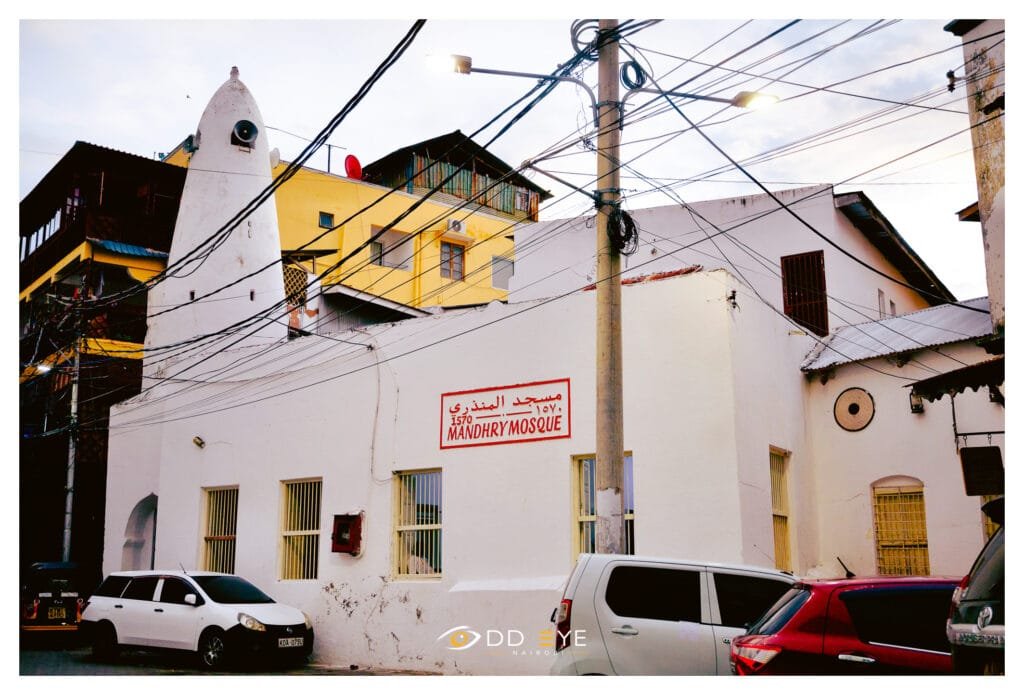
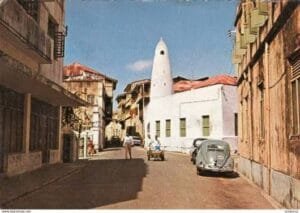
This is Mandhry Mosque, also known as Mandhry Masjid, whose origins are traditionally dated to 1570. Built in Swahili architectural style with a rounded minaret, this is one of only mosques in the world with two mihrabs. More than four and a half centuries later, it remains a living place of worship.
Before Fort Jesus, There Was Mandhry
To appreciate just how old Mandhry Mosque is, consider the chronology of some of Kenya’s most recognizable historical milestones:
- 1570/71: The establishment of Mandhry Mosque.
- 1593: The Portuguese begin constructing Fort Jesus.
- 1896: Construction of the Uganda Railway begins.
- 1899: Nairobi emerges as a railway settlement.
- 1963: Kenya attains independence.
Mandhry Mosque predates Fort Jesus by approximately 23 years and Nairobi’s emergence as a railway settlement by nearly 330 years. When the first railway workers arrived in what would eventually become Kenya’s capital city, generations of families had already worshipped at Mandhry. The mosque’s history spans Portuguese occupation, Mazrui administration, Omani rule, British colonialism and the birth of independent Kenya. Political powers changed. The mosque endured.
A 16th-Century Mosque in a 19th-Century Building
There is, however, an interesting distinction between the age of Mandhry Mosque and the age of the building standing today.
While the mosque’s establishment is traced to the 16th century, architectural records date much of the surviving structure to around 1830, towards the end of Mazrui rule in Mombasa. The Mazrui, an influential family of Omani origin, governed Mombasa with considerable autonomy for much of the 18th and early 19th centuries before losing control to the Sultan of Oman in 1837.
The distinction between the age of a building and the age of an institution is particularly important when documenting African heritage. Buildings are repaired, reconstructed and expanded. Their communities, traditions and cultural significance can survive these physical transformations. Mandhry is a fascinating example of this continuity.
When the Ocean Provided the Building Materials
One of the most remarkable aspects of Old Town Mombasa is how its architecture reflects an intimate understanding of the surrounding environment.
Mandhry Mosque was constructed using coral rubble and finished with lime plaster, materials characteristic of traditional Swahili architecture. Long before modern Portland cement became commercially available along the East African coast, coastal builders had developed sophisticated construction techniques using locally available materials.
Coral stone provided the structural foundation, while lime-based mortar and plaster helped bind and protect the walls.
Similar architectural traditions can be found across the historic Swahili settlements of Lamu, Zanzibar, Kilwa and other parts of the Western Indian Ocean coastline. These similarities tell a much larger story: centuries before modern national boundaries separated Kenya, Tanzania and Mozambique, coastal communities were connected through commerce, religion, migration and the exchange of architectural knowledge.
The Indian Ocean was not simply a geographical boundary. It was a corridor of civilization.
The Wall That Points Towards Mecca
Look closely at the northern wall of Mandhry Mosque and you will notice a projecting architectural feature. This is the exterior expression of the mihrab, the prayer niche that indicates the qibla, or direction of Mecca, towards which Muslims face during prayer. It is an easily overlooked detail, particularly for visitors unfamiliar with Islamic architecture.
Yet it speaks to a fascinating body of historical knowledge.
Centuries before GPS, digital maps and satellite navigation, Muslim communities across the world developed methods of determining the direction of Mecca using geography, astronomy and established religious conventions. The orientation of historic mosques along the Swahili coast offers another window into the intellectual and religious networks that connected East Africa to the wider Islamic world.
The Forgotten Well Across the Street
Perhaps one of the most intriguing features associated with Mandhry Mosque is not inside the mosque at all. It sits across the street. There stands a historic well whose decorative entrance structure bears the date 1901, Kisima cha Mandhry. Although the stone frontage bears 1901, historical accounts trace the well itself as far back as 1570. In an era before modern piped water became widely accessible, wells were essential components of urban infrastructure. Their significance was particularly pronounced around mosques, where water was needed for ablution, the ritual cleansing undertaken before prayer.
The well reminds us that historic buildings were rarely isolated monuments. They existed within interconnected neighbourhoods supported by infrastructure, social relationships and shared resources. Interestingly, the date on the well’s decorative structure places it around the same period that the Uganda Railway was transforming the economic geography of East Africa. While a new urban centre was emerging inland, one of Mombasa’s oldest neighbourhoods was continuing to develop around centuries-old institutions.
How Do You Expand a Centuries-Old Mosque?
Unlike a museum, a functioning mosque cannot simply be preserved in time.
Its congregation grows. Its needs change. New generations require space for worship, religious instruction and community activities.Originally a single-storey building, Mandhry Mosque underwent expansion works in 1988 and 1992 to accommodate changing community needs, including additional space for religious education and women attending prayers. These architectural interventions are documented in the archives associated with the Aga Khan Trust for Culture. They raise an important question that extends far beyond Mombasa:
How do we modernize African heritage without erasing the very characteristics that make it historically significant?
Mandhry represents an approach to heritage in which preservation does not necessarily mean freezing a building in the past. It can also mean allowing it to evolve while retaining its historical identity and original purpose.
The African Civilization the Portuguese Encountered
Perhaps the most significant story Mandhry Mosque tells is not about religion or architecture alone but about the way African history is narrated.
When Vasco da Gama arrived in Mombasa in 1498, he encountered an established coastal society with its own political institutions, commercial networks, religious traditions and architectural knowledge. Islam had already been present along the East African coast for centuries. Swahili merchants participated in extensive Indian Ocean trading networks connecting Africa with Arabia, Persia, India and, through wider commercial routes, Asia.
There were permanent settlements, sophisticated maritime economies and established systems of governance. European arrival did not mark the beginning of civilization along the East African coast. It marked a new chapter in the history of civilizations that were already there. Mandhry Mosque, established during the early period of Portuguese involvement along the coast, offers a tangible reminder of that much longer history.
The History We Casually Walk Past
There is something profoundly fascinating about a building that has outlived the political orders that once surrounded it.
The Portuguese lost their hold on Mombasa. The Mazrui lost their autonomy. Omani political dominance gave way to British colonial administration. Kenya eventually became an independent nation, and still, people gather at Mandhry to pray. More than 450 years after its establishment, the mosque has not become merely an archaeological curiosity or a monument to a vanished civilization.It remains part of everyday life.
What fascinates me most about Old Town Mombasa is how much of African history survives in the ordinary: in the walls we walk past, the wells we barely notice, the doorways we photograph and the buildings whose stories we seldom stop to ask about. Perhaps we have become so accustomed to looking for African history in museums that we have forgotten to look for it in our streets.
For those who grew up in Old Town Mombasa, worshipped at Mandhry Mosque or had relatives who lived in the neighbourhood, what stories about this place were passed down to you?
Some of our most valuable historical archives are not buildings or books. They are people.
The Future Has an Ancestry — an editorial series by The Power Dialogue Africa, exploring the overlooked histories, cultural knowledge, people and places that have shaped our continent.