
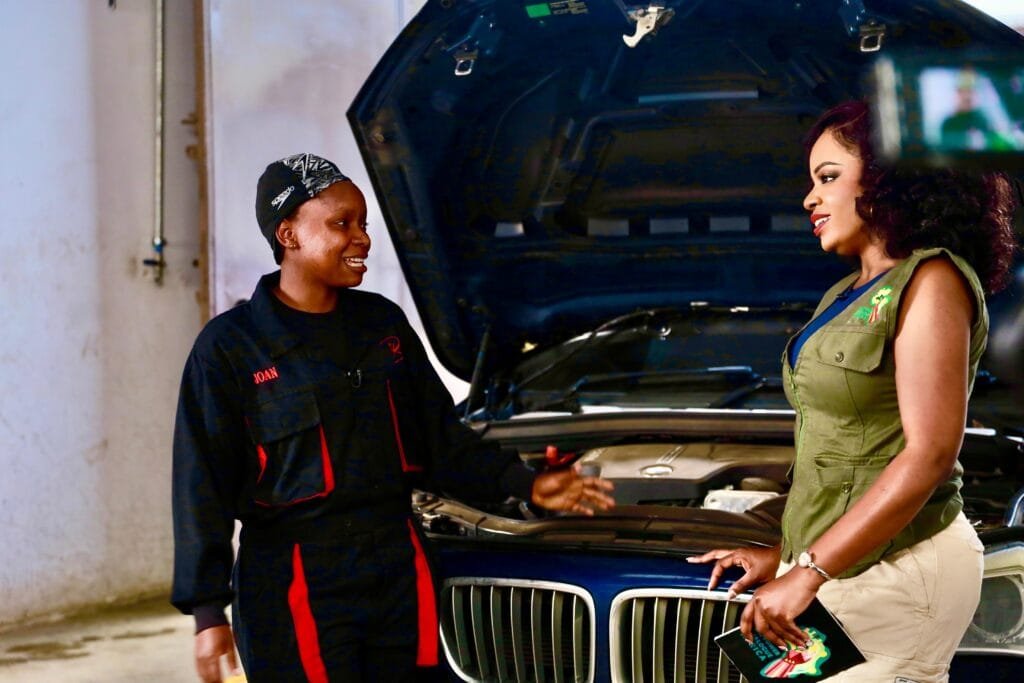
Joan Nyambura’s unlikely journey reveals how expertise—not muscle—is transforming Africa’s automotive industry.
In many African households, career conversations follow a script so predictable it could almost be laminated.
Doctor.
Lawyer.
Engineer.
These are the professions that make relatives nod approvingly across the table as someone passes the nyama choma. “Ah, mtoto wa so-and-so is now a doctor.” At that point even the quiet uncle who has been observing silently will clear his throat and say, “Very good.”
Now imagine announcing something slightly different. “I’m leaving medicine… to become a mechanic.” That sentence alone could freeze a family WhatsApp group long enough for three cousins to type “typing…” and then delete their responses.
But for Joan Nyambura, curiosity had already started pulling her in a different direction.
When Curiosity Meets Opportunity Joan didn’t fall in love with cars because of speed. Or luxury. Or brand names. What fascinated her was something deeper. Cars are systems. Sensors send signals. Computers interpret faults. Warning lights are essentially machines trying to communicate. And once she stepped deeper into the automotive world, she began noticing something curious about how many vehicles change hands in Kenya.
The Kenyan Way of Buying Cars
Buying a car in Kenya can sometimes resemble buying fruit at the market. You walk around. You look at the outside. You negotiate a little. Someone says “last price.” Hands are shaken. Deal done. Except in this case the fruit costs millions of shillings.
And this isn’t a small market.
According to the Kenya National Bureau of Statistics, Kenya imports over 80,000 used vehicles annually, with the majority arriving through the port of Mombasa. Across the continent, the numbers are even larger. A 2020 report by the United Nations Environment Programme estimated that over 40% of the world’s exported used vehicles end up in Africa. That means millions of buyers across the continent are navigating a complex market where information is often uneven.
And this is exactly where Joan saw an opportunity. The Diagnostic Advantage
Garages have traditionally been associated with muscle power. Heavy lifting. Spanners flying across engine bays. Grease everywhere. However, modern cars have quietly changed that equation. Today’s vehicles are closer to computers on wheels. They communicate through diagnostic systems. They store error codes. They reveal faults through data. Which means solving problems increasingly requires analysis rather than brute strength.
Joan realised that modern mechanics are becoming less like labourers and more like technicians and interpreters. Ironically, the diagnostic mindset she developed in medicine turned out to be extremely useful after all. Just applied to a different type of patient.
The Trust Economy
Listening to Joan speak, one insight becomes clear. Her business is not only about fixing cars.
It is about building trust. Because, in markets where information is uneven, trust becomes the most valuable service anyone can offer and the stakes are significant. In Kenya, a used vehicle can easily cost between KSh 800,000 and KSh 3 million, depending on the model. For many families, that represents years of savings. Helping buyers understand what they are actually purchasing isn’t just technical work. It’s financial protection.
The Bigger African Opportunity
Zoom out, and Joan’s story begins to reveal a larger pattern. Across Africa, the automotive sector is growing rapidly. According to the African Development Bank, Africa’s vehicle fleet is expected to triple by 2050, driven by urbanisation and a rising middle class. At the same time, the International Energy Agency estimates that the global automotive industry is undergoing its most significant technological transformation in a century.
Vehicles are becoming smarter, more connected, and increasingly dependent on digital diagnostics. That shift means the future of automotive work will require something very specific.
Knowledge.
That is exactly where professionals like Joan are positioning themselves.
From the outside, Joan Nyambura’s decision looked unconventional. Leaving medical school to enter a garage doesn’t immediately fit the traditional success script. But success scripts are changing. What Joan actually did was identify a growing market with a clear information gap and then build expertise where it mattered. She turned curiosity into skill. Skill into credibility and credibility into trust. Today she helps motorists make smarter decisions in one of the most important purchases they will ever make.
The Power Dialogue Africa Lens
At Power Dialogue Africa, we believe the continent’s most powerful stories often emerge from individuals who see problems others overlook. Sometimes innovation comes from building something entirely new. But sometimes, the most powerful innovation is much simpler. It is bringing clarity to systems people already depend on. Agriculture markets. Energy systems. Transport networks. Or in this case, a car sitting in a dealership yard waiting for its next owner.
Joan Nyambura didn’t just build a business. She built confidence in a market where uncertainty once dominated.
Confidence, in many ways, is the invisible infrastructure that powers economic growth. Which raises an interesting question for the rest of us watching Africa’s rise. Where else across the continent are markets waiting for someone curious enough to decode them? Joan just happens to do it under the hood of a car. However, the principle travels far beyond the garage. That is exactly the kind of African brilliance Power Dialogue Africa exists to spotlight.
🎙 Watch Joan Nyambura’s full conversation on Power Dialogue Africa on YouTube and listen on Spotify.