
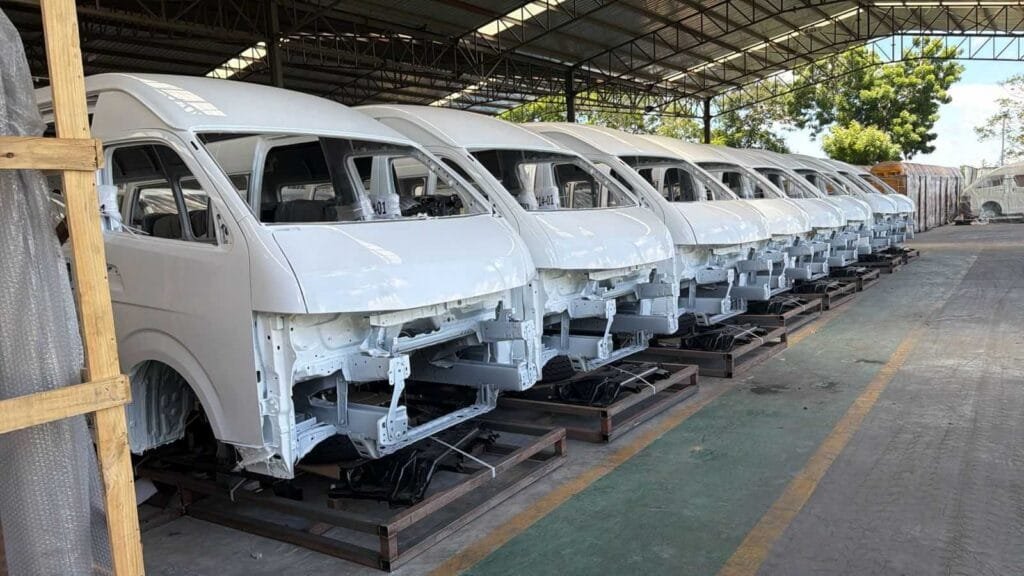
In Mombasa’s industrial corridor, Kenya has quietly crossed a threshold that much of Africa has long struggled to reach, moving from experimentation to industrialisation in electric mobility.BasiGo has begun assembling its Ma3e electric vans locally, with the first 22 units set for delivery within weeks. Built through CKD kits at Associated Vehicle Assemblers, the vans offer a range of roughly 300 kilometres, sufficient not for prestige routes, but for the daily grind of African transport economics and hopefully inter-county travel.The timing is deliberate. After ten months of live route testing across corridors such as Nairobi–Thika and Nyahururu–Nyeri–Nakuru, the company has accumulated more than 500 reservations, a figure that signals not curiosity, but demand.Yet this is not merely a Kenyan story. It is part of a broader continental shift still early, but increasingly coordinated.Across Africa, electric mobility is converging around a similar industrial logic, import components, assemble locally, finance innovatively and scale gradually. In Nigeria, for instance, local assembler Saglev has begun producing electric vans using Chinese kits, with ambitions of up to 2,500 vehicles annually. In parallel, new assembly agreements in Kenya beyond BasiGo are reinforcing Mombasa’s role as an emerging EV manufacturing hub.The numbers underline both momentum and limitation. Africa today has only about 30,000 electric vehicles on its roads, a fraction of the global total yet the direction of travel is unmistakable.What distinguishes the current wave from earlier efforts is not technology, but structure.First, local assembly is becoming the anchor. CKD models, long used in traditional automotive sectors, are now being repurposed for the energy transition allowing countries to build capability without the capital intensity of full manufacturing.Second, economics are shifting in favour of electrification. Operating costs for electric vans can be significantly lower than petrol equivalents sometimes as low as a fifth per kilometre turning sustainability into a financial argument rather than a moral one.Third, financing innovation is closing the adoption gap. Pay-as-you-drive and lease-to-own models pioneered by firms like BasiGo are tailored to a reality where most operators cannot afford upfront vehicle purchases.In this context, Kenya’s latest move is less an outlier than a signal. It suggests that Africa’s EV transition will not mirror that of Europe or China top-down, policy-heavy, and subsidy-driven but will instead emerge from fragmented, commercially grounded ecosystems.The implications are wider than transport. If scaled, such models could reduce fuel import dependency, ease pressure on foreign exchange, and anchor new industrial value chains within African economies. They also raise harder questions, can infrastructure particularly power and charging networks keep pace? And will policy frameworks evolve quickly enough to support, rather than constrain, this momentum?For now, the assembly lines in Mombasa offer a glimpse of what a distinctly African pathway to electrification might look like: pragmatic, modular, and quietly ambitious.Africa is no longer asking if electric mobility will scale but how. Which markets across the continent do you think are closest to tipping from pilot to true industrial scale and what will push them over the edge?